The Daily Circuit

How will Obama, Congress address fiscal cliff?

by Emily Kaiser, Minnesota Public Radio

9:06 AM, November 8, 2012

LISTEN

President Barack Obama doesn't have much time to celebrate his re-election. He must now confront the fiscal cliff — nearly $500 billion in automatic tax hikes and spending cuts set to take effect in January that could throw the nation back into recession.

With a divided Congress, what can we expect to happen next?

Steve Bell, senior director of economic policy with the Bipartisan Policy Center and former staff director of the Senate Budget Committee, joined The Daily Circuit Thursday.

"This has been played out many times," Bell said. "We always wait till the last second, we always cut some sort of deal, we always do it in the most clumsy and painful way disrupting both markets and people's lives. The assumption is that because that's the habit into which we've fallen, that's what will happen this time. I'm not sure that's true because the issues are very, very large in number and very complex."

This year, Congress has four to six years of things that have been put off for this lame duck session, Bell said.

"We have 22 working days in an atmosphere where people who've been defeated are still going to be making the decisions," he said.

Andrew Fieldhouse, federal budget policy analyst with the Economic Policy Institute, also joined the discussion. He said the issues will more likely be resolved in 2013. There are a number of actions Treasury Secretary Timothy Geithner and the Office of Management and Budget could take if needed to delay some of these automatic changes.

Fieldhouse said the framing of the fiscal cliff with the federal deficit is strange.

"What the fiscal cliff actually reveals is that budget deficits are closing too quickly, meaning public debt accumulating too slowly will push the economy into another recession," Fieldhouse said. "You've actually got a huge contraction built in between the current law baseline -- what's been legislated; between current policy; what people expect will continue; and what's been legislated for this year within the fiscal cliff."

Fieldhouse said we should be most concerned with the legislation enacted this year, including the expiration of the ad hoc fiscal stimulus payroll tax cuts and emergency unemployment benefits.

"Overall, the drag between what's enacted essentially for this year and next year is 3.7 percent of GDP," Fieldhouse said. "This really is enough to push the economy into recession. So you have to fundamentally reorient fiscal policy to accommodate economic recovery and that means moderating the pace of deficit reduction while the economy remains depressed."

A caller from Hastings said it is time for all Americans to help fix our country's economic problems.

"One of the things we have to accept is that we're all going to have to pay higher taxes," he said. "We went 12 years not collecting enough money to pay the government debts; we built up this huge debt now. We're going to have to address it."

Bell said that when discussing letting the Bush tax cuts expire to increase taxes, it's really important to think about it in a different context.

"Over the next 10 years, the Bush tax cuts will cost in lost revenue about $4 trillion," he said. "Three-quarters of that will go to people who make less than this magic $200,000 a year adjusted gross income. One-quarter of the Bush tax cuts will affect upper-income people... If the Bush tax cuts expire entirely, the people who will be hurt most will be people who used earned income tax credit, the childcare tax credit."

On the blog, Hilary said she would approve of shared sacrifice.

"I would be willing to pay higher taxes if there was some removal of tax exemptions," she wrote. "Additionally we need a smarter not bigger military, which should reduce costs. I also think that entitlements should be means-tested and possibly have the age to join increased. These ideas were all presented by both sides during the election. I know the details matter but there should be common ground."

MPR News' Madelyn Mahon contributed to this report.

comments powered by Disqus

The Daily Circuit live chat: Can we avoid the 'fiscal cliff?'

  • We'll get the conversation started on the radio at 9:06.

    by Stephanie Curtis, MPR NewsNovember 8, 2012 at 8:32 AM

  • From NPR this morning:

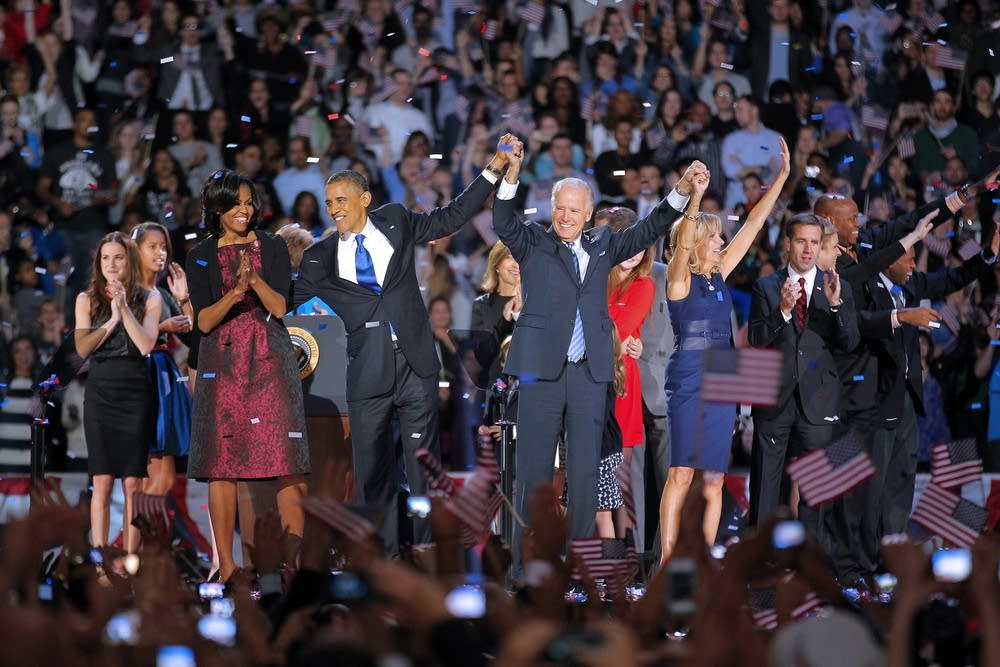
    "In his victory speech Tuesday night in Chicago, President Obama signaled his desire to find a compromise. He said the priorities for his second term include deficit reduction. Eighteen hours later at the Capitol, House Speaker John Boehner offered the president a tentative olive branch.

    "Mr. President, the Republican majority here in the House stands ready to work with you, to do what's best for our country," Boehner said."

    '

    by Stephanie Curtis, MPR NewsNovember 8, 2012 at 8:36 AM

  • Boehner talking about the fiscal cliff (start at 2:00 on this C-Span video):

    by Stephanie Curtis, MPR NewsNovember 8, 2012 at 8:47 AM

  • From Obama's victory speech:

    "Our economy is recovering. A decade of war is ending. A long campaign is now over. And whether I earned your vote or not, I have listened to you, I have learned from you, and you've made me a better president. And with your stories and your struggles, I return to the White House more determined and more inspired than ever about the work there is to do and the future that lies ahead.

    "Tonight you voted for action, not politics as usual. You elected us to focus on your jobs, not ours. And in the coming weeks and months, I am looking forward to reaching out and working with leaders of both parties to meet the challenges we can only solve together. Reducing our deficit. Reforming our tax code. Fixing our immigration system. Freeing ourselves from foreign oil. We've got more work to do."

    by Stephanie Curtis, MPR NewsNovember 8, 2012 at 8:54 AM

  • "We always wait unitl the last second....and do it in the most clumsy and painful that disrupts peoples' lives." - Guest Steve Bell on how Washington solves budget crises.

    by Stephanie Curtis, MPR NewsNovember 8, 2012 at 9:11 AM

  • Steve Bell, Senior Director of Economic Policy at the Bipartisan Policy Institute, served on the staff of U.S. Senator Pete V. Domenici (R-NM) from 1974 to 1986 and then again from 1996 to 2009. From 1981 until 1986 he was staff director of the Senate Budget Committee, which Senator Domenici chaired. Between 1986 and 1996, he was a managing director of Salomon Brothers of New York, and started that firm’s Washington, D.C., office.

    by Stephanie Curtis, MPR NewsNovember 8, 2012 at 9:11 AM

  • Unless a citizen served in the military, no Americans have had to pay for the wars. I would be willing to pay a 'war tax' to recover the expenses of Iraq and Afghanistan.

    by KariNovember 8, 2012 at 9:13 AM

  • @KerriMPR Strong middleclass = strong demand = strong economy=strong growth, repeat. Benefit only the top & you kill that virtuous cycle.

    by MBurnsvilleNovember 8, 2012 at 9:13 AM

  • @KerriMPR we have unrealistically low Fed tax burden for the wealthy? won't the middleclass consumer be hurt by an all cuts austere budget?

    by MBurnsvilleNovember 8, 2012 at 9:13 AM

  • Increase capital gains tax, increase taxes on the upper income earners, increase the retirement age, means testing for social security and medicare, decrease defense, and do something about income inequality.

    by Tom LenzmeierNovember 8, 2012 at 9:13 AM

  • Alan Simpson in the Wall Street Journal on the budget deal that led to the fiscal cliff:

    “There’s no way to escape this,” Mr. Simpson said. “They decided to build their own teeth in their shark when they put together this sequester. No one thought they would be stupid enough to go along with it.”

    by Stephanie Curtis, MPR NewsNovember 8, 2012 at 9:15 AM

  • I think we need shared sacrifice, I would be willing to pay higher taxes if there was some removal of tax exemptions, additionally wee need a smarter not bigger military which should reduce costs, I also think that entitlements should be means tested and possibly have the age to join increased. These ideas were all presented by both sides during the election. I know the details matter but there should be common ground

    by HilaryNovember 8, 2012 at 9:15 AM

  • There are millions of un and under employed that would be more than willing to be paying taxes. It's about the economy and good jobs. A stronger economy will go far to solving budget issues. increasing the national debt is without trimming spending is not prudent.

    by MrRWrightNovember 8, 2012 at 9:15 AM

  • Kerri's other guest is Andrew Fieldhouse, Federal Budget Policy Analyst, from the Economic Policy Institute.

    by Stephanie Curtis, MPR NewsNovember 8, 2012 at 9:16 AM

  • "If the Bush tax cuts expire, the people hurt most are the people who have earned income tax credits. Letting Bush tax cuts expire, we will have a lot of people who are lower income and middle incomes that will be hurt immediately." - Steve Bell

    by Stephanie Curtis, MPR NewsNovember 8, 2012 at 9:21 AM

  • @KerriMPR just 12 years ago Greenspan's projections say We'd be debt free this year. Who benifited from the red ink since Y2k, tax them?

    by MBurnsvilleNovember 8, 2012 at 9:22 AM

  • Sequestration defined and put in perspective by Huffington Post:

    "For the uninformed, sequestration is the across-the-board 10 percent cut in discretionary spending in the budget, including the Department of Defense budget, that is mandated by the Budget Control Act of 2011. The mandatory entitlement spending of the federal budget, Social Security, Medicare, Medicaid, will continue to grow, along with the interest on the national debt.

    If Congress is unable to reach a compromise on how to reduce our $16 trillion national debt, over $500 billion dollars in cuts to the defense budget over the next decade would be mandated to start Jan. 3, translating into a cut of about $55-60 billion for 2013."

    by Stephanie Curtis, MPR NewsNovember 8, 2012 at 9:28 AM

  • I'm concerened about child care tax credits going away. Is that a real possibility if Bush tax cuts expire? I'm just barely middle-class and depend on these types of benefits!

    by hutch_kristenNovember 8, 2012 at 9:29 AM

  • We must address entitlements.

    by Display Name: DaphneNovember 8, 2012 at 9:29 AM

  • @DailyCircuit Fiscal cliff- more about people panicking by the term "cliff" than anything else.

    by HarlanNovember 8, 2012 at 9:29 AM

  • @KerriMPR new revenue w/out increasing taxes, simple solution = drug policy reform, specifically decriminalization of marijuana

    by JesseJames November 8, 2012 at 9:30 AM

  • totally agree with guest that b/c it looks as if we've been running economic stimulus for ten years now as a matter of course (deficits through fiscal and very low interest rates as monetary). But, then what do we do moving forward? how do you fix it? Downsize our lifestyles by bringing down consumption?

    by Display Name:@finkster10November 8, 2012 at 9:39 AM

  • How can your guest really say that "real economic growth" occurred is it was direct result of Gov stimulus? We only increased the debt. Sounds like a 'false' growth. I think it'll only be 'real' if GDP grows and debt declines. That would be real growth.

    by MrRWrightNovember 8, 2012 at 9:39 AM

  • @KerriMPR How useful this discussion would have been BEFORE people voted. To hear the indictment of Obama's vision of stimulus in 2009

    by Tom MerrittNovember 8, 2012 at 9:39 AM

  • @KerriMPR exactly. perhpas our personal consumption and lifestyle has outgrown economic reality..

    by Andy FinkenNovember 8, 2012 at 9:40 AM

  • Read the Simpson-Bowles report.

    Here's part of the preamble:

    "Throughout our nation’s history, Americans have found the courage to do right by our children’s future. Deep down, every American knows we face a moment of truth once again. We cannot play games or put off hard choices any longer. Without regard to party, we have a patriotic duty to keep the promise of America to give our children and grandchildren a better life."

    Our challenge is clear and inescapable: America cannot be great if we go broke. Our businesses will not be able to grow and create jobs, and our workers will not be able to compete successfully for the jobs of the future without a plan to get this crushing debt burden off our backs."

    by Stephanie Curtis, MPR NewsNovember 8, 2012 at 9:42 AM

  • There is no doubt that closing corporate loopholes, increasing taxes on the top 1-2% of the population, and spending cut for defense MUST be on the agenda.

    I doubt that this will happen though, as the GOP sees their retention of the majority in the House as a mandate to continue with its obstruction, and that fiscal blackmail is a viable option to hold Americans hostage for the benefit of the very wealthy.

    by Leslie TylerNovember 8, 2012 at 9:44 AM

  • If we all agree to make shared sacrifice I.e. Be taxed, how do we ensure our politicians won't continue to spend more money and continue to increase the deficit?

    by KTNovember 8, 2012 at 9:47 AM

  • How much of the 75% of Bush tax cuts that go to those with less than $250,000 income go to people with less than median income, about $50,000? In addition to Bush tax cuts we had/have two wars and Medicare Part D on the U.S.'s "China" credit card. All of us with above median income can afford a "sliding scale" tax increase, depending on our income. This would remove the idea of "picking on" only the wealthiest to pay more to reduce the national debt.

    by Bill IrelandNovember 8, 2012 at 9:56 AM

  • That could easily be legislated into that particular piece of legislation, although I doubt that Congress will agree with it and fight limits tooth and nail in order to keep their special interest financiers happy (earmarks etc.).

    by Leslie TylerNovember 8, 2012 at 9:57 AM

  • I see a lot of people demanding that other people make sacrifices and don't offer up their own money to be sacrificed.

    We need to do tax reform which results in lower rates, elimination of deductions/credits and increased revenue. That means, yes, higher income people should pay more but so should many upper-middle class and middle class people.

    I'm more than willing to pay more in taxes in exchange for a much more efficient tax code where more people are paying something and those who are well off (yes even middle class people) pay a bit more...that 47% number is important and should be a lot closer to 20% of people (the truly poor) who pay no Federal Income Tax.

    by JeffersonNovember 8, 2012 at 9:57 AM

Listen Now

MPR News Radio

Hourly Newscast

The Daily Circuit Blog

Field Notes:

Field notes: How a school bus became a house

  When Adam Marcus told his graduate students to do something “full-scale” for their final project, he didn’t think the semester would end with a school bus-house hybrid parked behind Rapson Hall. “I said, ‘We’re going to do full scale,’” said Marcus, a University of Minnesota Architecture School design fellow. “And Hank said, ‘I’m gonna Read more

Politics & Government:

Three perspectives on bridging the marriage opinion gap

Now that Gov. Mark Dayton has signed the same-sex marriage bill into law, we asked the participants on this week’s Roundtable for advice on how to bridge gaps between Minnesotans who support same-sex marriage and those who oppose it. Jim Wallis, author of “On God’s Side,” thinks we are on the cusp of a nationwide Read more