


A wild and scenic stretch of river may soon be less so
Go Deeper.
Create an account or log in to save stories.
Like this?
Thanks for liking this story! We have added it to a list of your favorite stories.


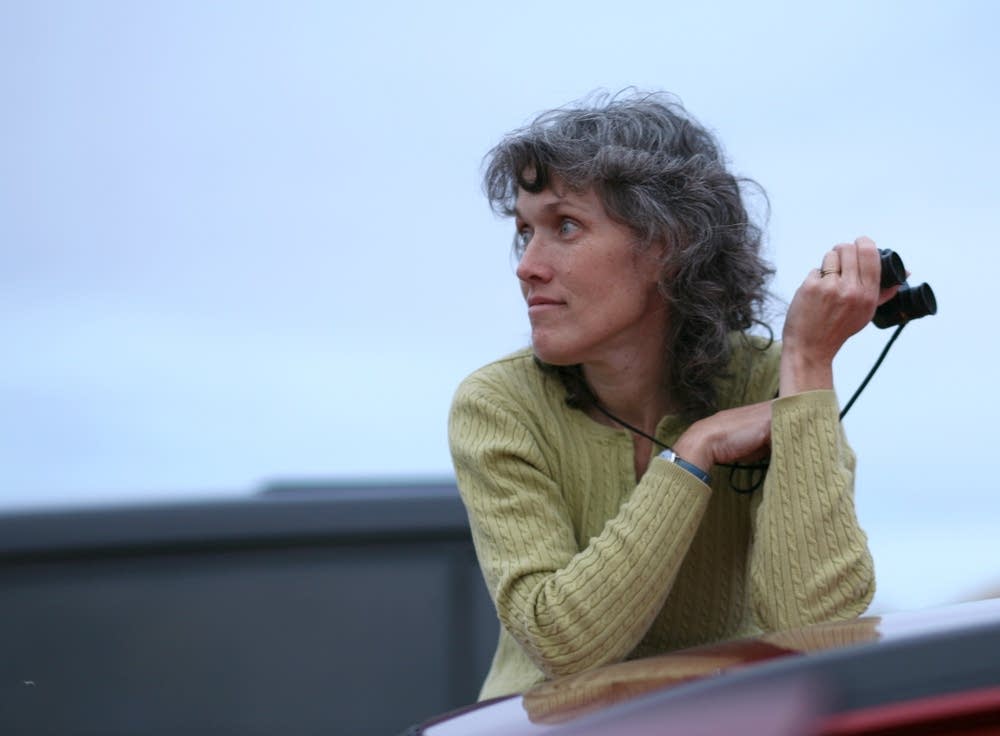
By Laurie Allmann
Laurie Allmann is a poet and environmental writer based in the St. Croix Valley.
It's a clear October day just ahead of a cold front when I head toward Log House Landing on the St. Croix River. I turn off of Scenic Hwy. 95, cross a set of railroad tracks, then travel down a steep incline toward the river, passing small homes and cabins tucked into the woods on either side. It's now considered part of Scandia, but locals and old maps remember this little river community as Otisville, a name dating from 1859 when steamboats still pulled ashore at the landing here.
I carry my kayak to the water's edge and wade out until it floats freely before climbing in. I push off from shore, then swing the pointed bow around to north like a compass needle. The river's current is weak this time of year, especially given the drought. With a wind out of the south, it can be easier to go upstream than down.
Turn Up Your Support
MPR News helps you turn down the noise and build shared understanding. Turn up your support for this public resource and keep trusted journalism accessible to all.
After a few awkward strokes, the paddle finds its rhythm. In minutes the kayak is gliding between forested bluffs in a panorama of color. The river is flanked by oaks in shades of copper and burgundy, the orange flares of maples, and clusters of pale-skinned aspen with their whispering yellow leaves; all reflecting in the waters near shore. It is a scene so lovely that it seems surreal, as though I have found my way into some parallel existence where all the usual rules are suspended. I feel as I did this past summer, on an overlook with a vista of the High Sierras in Yosemite. All around me, people were either hushed to silence at the sight, or erupted in bursts of laughter at the improbable, surprising beauty of the world.
The St. Croix is designated as a National Wild & Scenic Riverway, and hundreds of thousands of people come here every year. Still, it is possible, even on the more populated lower St. Croix, to find oneself alone on the river, to be swept by its grandeur as if yours were the first eyes ever to come upon it. It is places like this, says my 15-year-old son, where you remember that you're not just from a city or a town, but from a planet.
I hear the cry of a hawk, and look up to see a pair of broadwings riding the updrafts along the valley ridge. I raise my binoculars, and realize that above them are still more hawks, a whirling tornado of migrating birds filling every depth of the sky. I watch as they spiral higher and higher until I can just barely make them out, tiny specks against the blue.
When these hawks return next spring, they could find this stretch of river a very different place. In the coming weeks the city of Scandia will consider whether to approve a conditional use permit that would allow the Tiller Corporation to operate a 64-acre gravel mine atop this very river bluff. A fringe of trees would block the view of the mine from the river. But according to an environmental review of the project, people down on the river could expect to hear noise from the mining operation: the sounds of excavating equipment and trucks removing 1.2 million tons of gravel from the site for as many as 10 years.
There's no guarantee it won't be longer. The current proposal calls for reclamation of the site after the gravel is removed. But conditional use permits don't have expiration dates. And the elephant in the room is the documented resource of valuable frac sand, in the form of Jordan Sandstone, which lies within 50 feet of the surface at the site.
This is a mining company that knows about frac sand. The Tiller Corporation was in the news last April for the failure of a containment berm at its Grantsburg mine, resulting in a spill of sediment that choked a wetland and then a tributary stream before making its way to the St. Croix. The spill went unnoticed by the mining company, continuing until a hiker eventually discovered the fouled stream. The incident is under review by the Wisconsin Department of Justice for possible legal action against the mine owners and operators. Meanwhile, the city of Scandia weighs this new request by the Tiller Corporation for a conditional use permit to operate a mine on yet another reach of this National Wild and Scenic River.
So I come here today to do something I may not be able to do this same time next October. I come to listen to the sounds of the river.
I lift the paddle from the water and let the kayak drift. In the ensuing quiet the familiar sounds of the river emerge, layer upon layer. I hear the trickle of creeks fed by perennial seeps and springs; cold water creeks where native brook trout move like ribbons in the riffles and rocky runs. I hear the drone of male cicadas and a rustle in the underbrush that reveals itself as a wood thrush with cinnamon brown shoulders and streaked breast. It's pushing its luck to leave so late in the season, foraging in the leaf litter to put fat on its small frame, fuel for the coming night flights to wintering grounds thousands of miles away in Nicaragua, Panama, Colombia. I hear the purr of an outboard motor, and turn to see a fisherman approaching in his boat, the tip of his fishing rod leaning out over the water. I lift a paddle blade in greeting and he smiles and nods as he passes, going slowly enough that he leaves no wake. I watch as he makes his way upstream, cuts the engine and casts a line.
As managers of this part of the riverway, the National Park Service has urged the city of Scandia to consider the significant impacts that mine noise would have on people's experience of the river here. The valley and water surface act as an amphitheater, carrying sounds far from their source, so the effects could be expected to extend beyond the immediate vicinity of the mine.
No one expects that the area be regarded as wilderness. Already, people using the river contend with the sounds of passing planes and tractor-trailers climbing the grades on scenic 95 beyond the bluff line. River users themselves generate a certain amount of noise. But these sounds come and go. For the most part, the sounds of the mine would come and stay. Under the city's development code, mines can operate from 7 a.m. to 7 p.m., five days a week. It remains to be seen what conditions, if any, the city might impose on the operation of the mine if a permit is granted.
In these hard economic times, we can take a lesson from an even tougher period in our history. During the Great Depression, attendance at National Parks around the country skyrocketed. At all times, but especially in the hardest times, we need places where we can be restored, where we can feel wholly and wondrously alive, places where we can, in the words of Wendell Berry, "come into the peace of wild things."
This year, 2012, is the 40th anniversary of the lower St. Croix's inclusion in the National Wild & Scenic Rivers system. As long as this river runs, we can count on an infinite stream of development proposals, whether they be for gravel mines or bridges. If the standard approach is to approve all such proposals, even with conditions attached or compromises of scale, soon the river valley will have lost the very qualities that draw people to its shores. It will be so diminished as to lose not only its ability to support wildlife, but its essential ability to enrich the lives of people for generations to come, for my children and yours. The values of this National Wild & Scenic River are afforded to us all in equal measure. Our assets are on the table. The question of who gains and who loses is ours to ask.
I hear the calls of sandhill cranes coming from somewhere upstream, beyond the river's bend. I hold my breath and listen for more.

Dear reader,
Your voice matters. And we want to hear it.
Will you help shape the future of Minnesota Public Radio by taking our short Listener Survey?
It only takes a few minutes, and your input helps us serve you better—whether it’s news, culture, or the conversations that matter most to Minnesotans.


