


Tracking the tombstone trends
Go Deeper.
Create an account or log in to save stories.
Like this?
Thanks for liking this story! We have added it to a list of your favorite stories.


When tombstone artist Jim Larson began his career, there were really only two things his Twin Cities clients wanted carved into their stones: Christian crosses and roses.
Thirty years later, things are much different.
"We've even put slot machines or decks of cards on 'em," Larson says. "If that's what's important to a person then, by golly, we'll find a way to get it on there."
Larson is a long-time employee of Schoenrock Memorials in St. Paul. Over the decades, he's seen his customers turn away from traditional images, opting instead for more individualized ones.
Turn Up Your Support
MPR News helps you turn down the noise and build shared understanding. Turn up your support for this public resource and keep trusted journalism accessible to all.
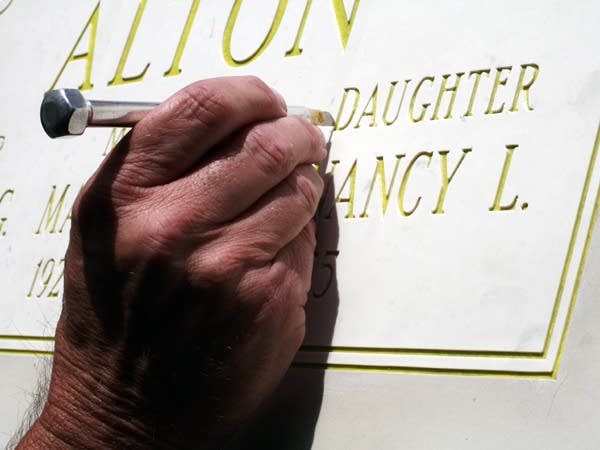
"If they were into dogs or cats, they'll put that dog or cat on or even a specific breed," he says. "I'll bet I've done 200 different animals everything from dolphins to turtles to frogs to fish." (View more photos)
When it comes to personalized tombstones, St. Paul's Oakland Cemetery has one of the best displays around.
Next to a memorial proclaiming that the deceased is "Asleep in Jesus," there's a granite marker with a beer bottle etched onto it.
One stone shows the image of a pick-up truck. Under it, in white letters, is the word "Toyota."
There's a marker with one of those Grateful Dead dancing bears on it and one with a steaming bowl of what appears to be soup.
Then there's the grave that boasts carvings of both a television set and a hundred-dollar bill.
Those headstones, of course, are a far cry from the ones found in the older sections of the state's cemeteries.

Instead of referencing the deceased's prized possessions or preferred alcoholic beverages, stones erected in the late 1800s almost always alluded to an afterlife. Many showcased images of wheat, a symbol of rebirth and resurrection. Others displayed carvings of an index finger pointing straight up, indicating that the soul of the departed had risen to heaven.
According to funeral director Thomas Lynch, these old tombstones show just how much religion influenced people's lives -- and deaths.
"The furniture of heaven was well known to former peoples for whom their religiosity instructed them about what would happen when they were dead," he says. "Every religion provided a view of what was next."
As an author, commentator and everyday philosopher, Lynch has spent lots of time pondering the way Americans view mortality. He says we used to rely on religion to guide their understanding of life and death. Thus, all those angels and crosses gracing the cemetery grounds. As as more of us have turned away from religion, he says, we've become less certain about what happens to our loved ones when they die.
"When we knew what was on the other side, when we said 'Mother's going to heaven' or the happy hunting grounds or whatever oblivion we consigned her to, we had a sense of it. We were bold enough to imagine it. So getting the departed to that shore was not frightening.

"But when we can't imagine the shore, the other side, because intellectually we just don't take it on board, then we're left with our hobbies and pasttimes and the rest of it. So we're no longer burying dead Methodists and Muslims and backslidden Catholics or Orthodox Jews. Now we are burying bikers and bowlers and gardeners and motorcyclists."
When people cover tombstones with golf clubs and sports cars, argues Lynch, they're simply avoiding the gravity of the situation, that someone's life has ended.
Back at his workshop, Larson is putting the finishing touches on a grave marker. Etched out of the shiny black granite is a log cabin surrounded by a forest of trees, a representation of the place the deceased loved to vacation with his family.
"People want to have some record, not because they've died, it's because someone has lived. These are the sorts of things people like to be remembered for, the images that were important to them."
And if that means a gravestone with etchings of a bingo card and a bottle of Dr. Pepper, well, that's life.


Dear reader,
Your voice matters. And we want to hear it.
Will you help shape the future of Minnesota Public Radio by taking our short Listener Survey?
It only takes a few minutes, and your input helps us serve you better—whether it’s news, culture, or the conversations that matter most to Minnesotans.


