Pencils ready? It's testing time for Minnesota schools

When Pablo Ramirez heard his diploma would hinge on a math test called the GRAD, he was worried.
"Probability kind of was a tough thing - I just didn't understand," said Ramirez, in an interview. "The word problems kind of get to me a little bit because the way they word them, it just don't make sense."
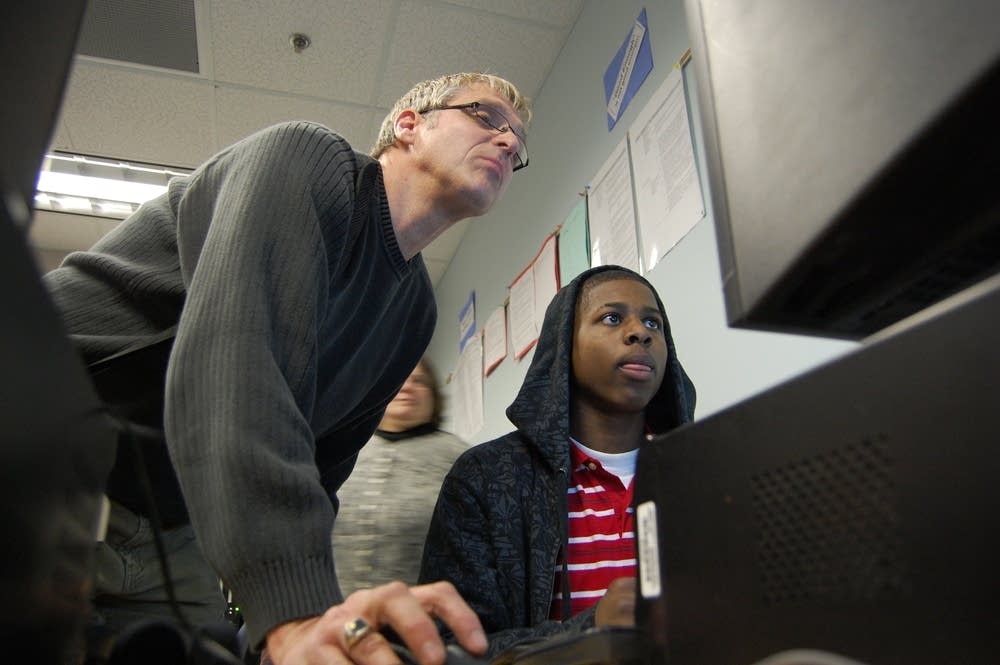
So Ramirez and other struggling students at Edina High School were put into a new, two-year course this year called eMath.
Everyone in eMath learns something different at a different pace. They all start with a computer test that determines which areas each student needs the most work in.
Create a More Connected Minnesota
MPR News is your trusted resource for the news you need. With your support, MPR News brings accessible, courageous journalism and authentic conversation to everyone - free of paywalls and barriers. Your gift makes a difference.
Students do still learn as a group from a teacher. But there's no textbook, everyone keeps a journal and a lot of time is spent working individually on tailor-made curriculum.

With that structure, Ramirez is now certain he'll pass the GRAD test.
"In my last class, advanced algebra, I wasn't moving at fast as the other students," Ramirez said. "Some of the concepts were too hard for me to get.
"In other classes, they'll let you fall behind but here, they won't let you do that. They'll make you understand everything that you need to understand."
Ramirez is a junior at Edina High School, which has as good a reputation as any in Minnesota. When leaders of this school started raising concerns that many of their kids might fail and miss graduation, lawmakers took notice.

If it's a problem for Edina, the thinking went, it's a problem everywhere.
Teacher Bob Schneider helped create e-Math at Edina. He freely admits that part of the class is teaching to the test and teaching kids how to take tests.
But along the way, something cool happened. EMath also became a pretty good way to teach math, Schneider said.
"I think what we've stumbled on something that works for all kids, because the test thing was looming and it forced us to do something and what we've done, I think, transcends the test," he said.
Still, Schneider is certain there will be students who fail the GRAD. For one, his course isn't available to all Edina students - and not every school was able to add such a course this year.
This week, 11th-graders will see a math test with 85 questions. Some count toward a score that eventually determines whether schools are meeting federal benchmarks.

Others will count towards the GRAD test and students won't know which questions count towards which test.
When 11th-graders took this test last year, nearly two-thirds of them were graded as not being proficient. But last year wasn't tied to graduation -- this year is. So does that mean two-thirds of this year's juniors won't get a diploma? Probably not, but it's still resulted in a lot of talk at the Capitol.
Legislators are considering a proposal that would require those who fail the math test to re-take the test twice in order to graduate. If they still fail, they can graduate if they've passed all their other required courses at their school.
Critics say that just amounts to a policy of 'three strikes and you graduate.' The Minnesota Department of Education says the fix must include a way for colleges and employers to know if someone is ready for life after high school. Letting students graduate without passing such a test diminishes the value of all diplomas, the department says.
Negotiations will continue at the Capitol while the state will release numbers in June on how many students passed the math test and the rest of the results of MCA IIs. The hope is to know by then just what to do with those who didn't pass.
Discussions on a solution started back in December, which means if you're scoring at home, the GRAD math issue has gone unresolved almost as long as Minnesota's U.S. Senate election.
