'Madness in a bottle' makes a comeback

Ernest Hemingway wrote about it. Pablo Picasso painted it and Vincent van Gogh sliced off his ear while drinking it.
Absinthe has been a liquor of legend for more than 100 years and it has been illegal for almost as long. In 1912, the U.S. Department of Agriculture banned the beverage, arguing that the green tonic caused "hallucinations and insanity."
This year, absinthe made its way back into the good graces of the government. On Dec. 27, 2007, the formerly forbidden libation went on sale in Minnesota.

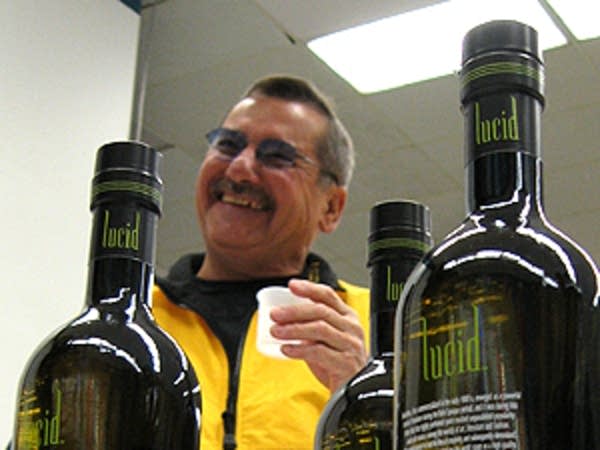
At 8 a.m. on this winter morning, dozens gather around a folding table in the corner of the Surdyk's wine department. The Minneapolis liquor store is giving out free samples of its very first shipment of absinthe. It is also selling bottles for $75 each.
Create a More Connected Minnesota
MPR News is your trusted resource for the news you need. With your support, MPR News brings accessible, courageous journalism and authentic conversation to everyone - free of paywalls and barriers. Your gift makes a difference.
Serving up the shots is a woman with a pair of wings attached to her back -- a nod to The Green Fairy, one of absinthe's many nicknames.
Waiting patiently next to a shelf of mudslide mix is a lawyer on his way to work; a retired couple from the suburbs; a woman donning a fur coat and dark sunglasses; and a guy with bare legs sporting 1970s-style flip-flops. They are all here to try "the queen of all poisons," as absinthe was once known. As it turns out, the taste reminds most people of black jellybeans. "I love anise. I love fennel. It only makes sense to combine it with liquor," says one man.
"It just tastes wonderful," shares a woman holding a small child. "It's like, 'Mmm mmm mmm.'"
"I haven't eaten breakfast yet, so it made me feel good," adds a third customer.
Historically, absinthe was associated with hedonism and madness. But on this day, imbibers just stand quietly, swirling the absinthe around and around in their little plastic cups as if they are at a wine tasting.

"I haven't seen anybody cut their ear off yet this morning," jokes store owner Jim Surdyk.
In reality, the likelihood of absinthe-induced hallucination is pretty much nil. But no one knew that until just a few years ago.
For generations, absinthe was believed to contain high levels of thujone -- a naturally occurring chemical that, in high doses, can cause seizures or even death.
After years of research, American chemist T.A. Breaux was able to prove that vintage absinthe contained only trace amounts of thujone.
"One would die of alcohol poisoning several times over before feelings any effects of thujone or anything like that," says Breaux.
It was Breaux's work that prompted governments around the world to reconsider their bans on the beverage.

But, if it was not the thujone, just what led to absinthe's downfall? Breaux says, to answer that, you need to travel back to 19th century Europe -- at least mentally.
Today, France is known for its wine. But back in the 1880s, the country's national drink was absinthe. Instead of happy hour, Parisians enjoyed "green hour." Evenings almost always began with a few glasses of the emerald-colored liquor.
The popularity of absinthe infuriated the wine industry, and it did everything it could to demonize the Green Fairy. Soon petitions were circulating, proclaiming that absinthe "provokes epilepsy and tuberculosis" and will make people "crazy and criminal."
Switzerland was the first to ban absinthe, after one of its citizens was convicted of murdering his entire family after drinking two glasses of the stuff. No one seemed to care that, over the course of the day, the man had also downed several liters of wine, six glasses of cognac and a brandy-laced cup of coffee.
Bad press, coupled with the growing temperance movement, prompted a backlash against the once-popular potion. Before long, the beverage was banned everywhere from France to the United States.
Absinthe may have gotten a bum deal, but it would be untrue to say the slighted spirit never led to any debauchery. Absinthe may not have turned people into "raving psychopaths," as the papers once claimed. But it likely made them quite drunk.
While wine averages 12 percent alcohol, the alcohol content of absinthe is typically 60 percent. That just might be enough to motivate a deeply disturbed Dutch painter to take a chunk out of his own ear.
Back at Surdyk's, customers continue to pass up the Malibu rum and the espresso-flavored vodka for a sample of the Old World.
The newly legalized absinthe is made exactly as it was 100 years ago. It is the same spirit that inspired the French impressionists and fueled painters like Degas and Manet.
Toulouse-Lautrec loved absinthe so much he had his cane hollowed out so he could fill it with the then trendy tonic. The eccentric artist even trained his pet bird to drink absinthe.

"It lights a fire," proclaims one taster.
For these Minnesotans, it is the liquor's lore, not its rumored hallucinogenic effects, that draws them to the drink.
"You can't taste this without thinking about the history, and all the legends of all the famous people who probably sat down and commiserated day after day after day, and this was their drink."
And, really, who doesn't need a shot of nostalgia every now and then?


